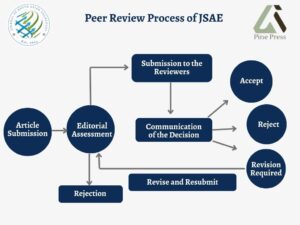
The Journal of South Asian Exchanges (JSAE) is committed to maintaining high standards of academic integrity and quality through a rigorous peer review process. The journal follows a Double-Blind Peer Review Process, ensuring that the identities of both authors and reviewers are concealed throughout the review process.
The steps followed by the Journal of South Asian Exchanges in the Peer Review Process are:
- Submission of the Article: Authors submit their manuscripts to the Managing Editor of the journal at editor@saexchanges.com following the submission guidelines of the journal.
- Editorial Assessment: Submitted articles undergo evaluation by the editors to assess their alignment with the aims and scope of the Journal of South Asian Exchanges. Articles failing to meet the primary criteria will be promptly rejected, and the author will be notified of the decision.
- Submission to the Reviewers: If the editors find the submission satisfactory, they select external reviewers, who are experts in the field, to evaluate the manuscript. Reviewers assess the manuscript’s quality, originality, methodology, and significance. They provide detailed feedback and recommendations.
- Communication of the Decision: Within two months, authors will receive communication regarding the decision on their submitted article, along with reviewers’ comments.
- Revisions: The editors may provide guidance to authors for revising the article before publication. If revisions are requested, the author revises the manuscript and resubmits it.
- Final Decision: After reviewing the revised manuscript, the editors make a final decision. Authors, whose manuscripts are accepted for publication get Acceptance Letter from the Editor-in-Chief of the Journal of South Asian Exchanges.
What is a Double-Blind Peer Review Process?
In the double-blind peer review model, both authors and reviewers remain anonymous to one another, with only the editor privy to the identities of all participants. This framework mitigates potential bias by ensuring that assessments are not influenced by personal or professional associations. Given that reviewers are typically specialists in the manuscript’s subject area, they may possess preexisting relationships or competing interests. Preserving author anonymity serves to uphold the integrity of the evaluation process by safeguarding the reviewer’s objectivity.
How to Review a Manuscript?
Step 1: Invitation to Review
Based on your expertise, the Managing Editor of the Journal of South Asian Exchanges will invite you to review a manuscript with the abstract of the manuscript. You are expected to respond to the invitation as soon as possible with your decision whether to conduct the review process or not. The review should be done within twenty working days after the acceptance of the manuscript
Step 2: Accessing the Manuscript for Review
Once you accept the abstract for review, you will get the blind manuscript for review. JSAE follows a double-blind peer review, so the identities of both the author/s and the reviewers are concealed.
Step 3: Initial Assessment
The following things, not limited to, should be considered in this stage of reviewing a manuscript:
- The manuscript’s relevance to the journal’s scope.
- Structure of the manuscript.
- Clarity of the data provided in the manuscript.
Step 4: Detailed Evaluation
The following things, not limited to, should be considered in this stage of reviewing a manuscript:
- Originality of the manuscript
- Clear description and appropriateness of the research methodologies followed by the author/s.
- Literature Review.
- Clarity and conciseness of the language.
- Relevance and integration the visuals, tables used in the manuscript.
- Citation in APA style
- Formatting guidelines of the journal.
Step 5: Preparation of Review Report
A detailed review repot should be prepared by the reviewers in the form to be provided to them by the editorial team of the journal.
Step 6: Submission
Submit the reviewed manuscript and the review report within the deadline.
Best Practices for Reviewers
- Declaring Conflict of Interest
- Maintaining Confidentiality
- Keeping up the time schedule
- Ensuring the quality of the manuscript